

If you’re searching for AC repair in Denver right now, your system has probably already quit and you want to know two things. What’s wrong with it, and how fast can someone get here.
I’ve been in the trades for more than 27 years, going back to my 1998 apprenticeship. I earned my Colorado Master Plumber license in 2007 and my ICC National Standard Master Mechanical certification in 2013, which covers HVAC, boilers, and mechanical systems. In that time the failures have repeated more than you’d expect, so let me walk you through what we actually find, what causes it, and what you can rule out yourself before paying anyone to come look.
Check your thermostat first. Confirm it’s set to cool rather than fan only, and that the target temperature is below what the room is reading. It sounds too simple to matter. It’s also a service call we get more often than I’d like to admit.
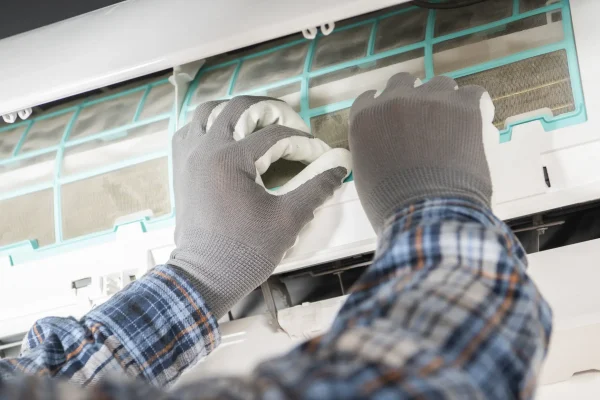
Then pull your air filter and hold it up to a light. If you can’t see through it, that’s your first suspect, and replacing it costs a few dollars instead of a diagnostic fee.
Last, check the breaker for your outdoor unit. A tripped breaker leaves your indoor blower running and moving air while nothing is cooling it, which is exactly what a much more expensive failure feels like from inside the house.
If all three check out and the house still isn’t cooling, something in the system needs a technician. Call us at (720) 542-8153.
Colorado’s temperature swings are hard on air conditioners. A system that runs through a hot afternoon and then sits through a cool night expands and contracts far more than equipment in a steadier climate, and over a full season that adds up.
That’s the local context I’ll stand behind, because it’s what I see in the field. It also means Denver systems tend to show their age a year or two earlier than the manufacturer’s number suggests.
This is the most common call we get in July. Five causes account for almost all of them: a refrigerant leak or low charge, a clogged filter choking airflow, a thermostat that’s set wrong or has stopped reading the room, a dirty condenser coil that can’t shed heat, or a tripped breaker on the outdoor unit.
If you worked through the checks above, you’ve already cleared three. That leaves the refrigerant charge and the condenser coil, and both need somebody with gauges.
One thing I want to be clear about, because it comes up constantly. Refrigerant isn’t consumed in normal operation, so if your charge is low, you have a leak. Anybody who tops off your refrigerant without finding that leak is selling you the same repair again next summer.
If a fresh filter doesn’t restore airflow, we’re usually looking at a failing blower motor or an evaporator coil that’s restricted or iced over.
Those two feed each other. A restricted coil chokes airflow, poor airflow drops the coil temperature further, and the coil ices harder. By the time a homeowner calls, both are usually happening at once, which is why we measure airflow on every visit instead of treating it as a symptom of something else.
Not all noises mean the same thing, so it’s worth knowing which ones are urgent.
Banging or clanking from the outdoor unit means shut it down. That sound usually means something is loose or broken inside the compressor, and another cycle can take a repairable problem past the point of repair.
Rattling is less serious, often a loose access panel or debris pulled into the cabinet, and you can safely look for something obvious. Squealing points to a worn bearing or belt in the blower assembly. A couple of clicks at startup and shutdown are normal, but continuous clicking after the system tries and fails to start usually means a relay or capacitor is going.
If your AC has quit or it’s making a noise that worries you, call (720) 542-8153.
Short cycling means the system starts, runs briefly, shuts off before the house comes down to temperature, then starts again. This is a serious problem. Homeowners tolerate this longer than any other symptom, because technically the AC is turning on.
It’s also one of the most damaging things a system can do. Startup is when a compressor works hardest, and repeated cycling stacks that load over and over, which wears a compressor faster than almost any other operating condition.
Causes range from a low charge to a dirty evaporator coil, an electrical fault, a thermostat misreading the room, or a system that was oversized at installation. Because that list is so broad, this one needs measurement rather than guesswork.
Two likely sources. The condensate drain is clogged with algae or dust, which is a straightforward repair. Or the coil froze and the ice is melting faster than the drain pan can carry away.
I don’t treat this one as cosmetic. When debris blocks the drainage system, water pools and creates the conditions mold needs, and then every cycle circulates it through your house. The stain on the floor is the visible part of a problem that’s already in your air.
If you see ice on the refrigerant lines or the coil, shut the system off and switch the fan to on so it can thaw before we arrive. Running a frozen coil is hard on the compressor.
We run a standardized inspection checklist on every AC diagnostic. That covers the compressor, condenser coil, evaporator coil, refrigerant charge, indoor airflow, filter drier, metering device, wet and dry bulb delta T, and thermostat reset.
We work the whole list, not just the part that looks obviously wrong, because air conditioners fail in sequence. Replace a capacitor and leave a low charge unaddressed, and you’re calling us again in three weeks, annoyed, and rightly so.
The same checklist runs on every AC repair visit, and it’s how we keep repeat calls down. It applies across evaporative coolers and heat pumps too, since airflow, electrical, and drainage cause most failures regardless of what’s sitting outside your house. Our full range of cooling services covers all three.
You get the price before we start. Every time. Finding out what something cost after the work is finished is exactly what teaches people not to trust contractors.
What a repair runs depends on the part, whether it’s in stock, and how accessible your equipment is, so a technician has to see the system to quote it accurately. But the quote comes before the wrench turns, and you decide from there with the full number in front of you.
If the repair is a big one and the timing is bad, we offer flexible financing through GoodLeap so a system you need working doesn’t sit broken while you sort out a budget. You can buy now and pay later on a more manageable monthly payment.
I’d rather repair your system than sell you a new one, and most cooling problems can be solved with a repair. Capacitors, contactors, fan motors, thermostats, and drain lines are all routine fixes on an otherwise healthy system.
Replacement starts making sense when the system is old, no longer covered under warranty, when the repair cost exceeds budget, if you have older refrigerants or when the same components keep failing. Stack other signs on top of that, foul odors from the vents, energy bills that don’t match your usage, or short cycling that persists after a repair, and you’re usually looking at equipment near the end of its lifespan.
When I see a system in that condition I’ll tell you plainly what I’d do if it were my house. If replacement is the call, our AC replacement options are worth reviewing. If it’s borderline but working, an AC tune-up will show you how much life is left.
Almost everything above announces itself early. The failures that leave people sitting in a hot house in July are visible during a spring maintenance visit, months ahead.
There’s a financial case too. According to the U.S. Department of Energy, proper preventative maintenance can cut utility bills by as much as 30 percent once a system is running at peak efficiency, which is money you’re spending either way.
That’s the argument for preventative AC maintenance, and it’s why we built the Total Home Care Club membership around annual inspections and tune-ups, priority scheduling, member discounts, and emergency assistance access.
We show up when we say we will, quote the price before we start, and stand behind the work with a 100% satisfaction guarantee. That’s been the promise since I started this company in 2012, and about 15,000 to 20,000 jobs later it hasn’t changed.
If your AC has quit, call (720) 542-8153 or schedule service today.
Same-day availability is common for us, and sometimes we're on-site within one to two hours of the call, even when it isn't an emergency. We're a family-owned company rather than a franchise running a packed corporate schedule, so there's real flexibility in the day.
We schedule service from 7am to 9pm, seven days a week. For emergencies, we're available 24 hours a day.
We cover Denver, Arvada, Aurora, Broomfield, Commerce City, Lakewood, Thornton, and Westminster. The full Denver metro service area is listed if you're not sure about your address.
Warm air while the outdoor unit is running, ice on the refrigerant lines or indoor coil, and a system that runs continuously without cooling the house.
Yes, along with heat pumps and conventional central air, for homes and commercial properties.
Yes, through GoodLeap, for repairs and installations both.
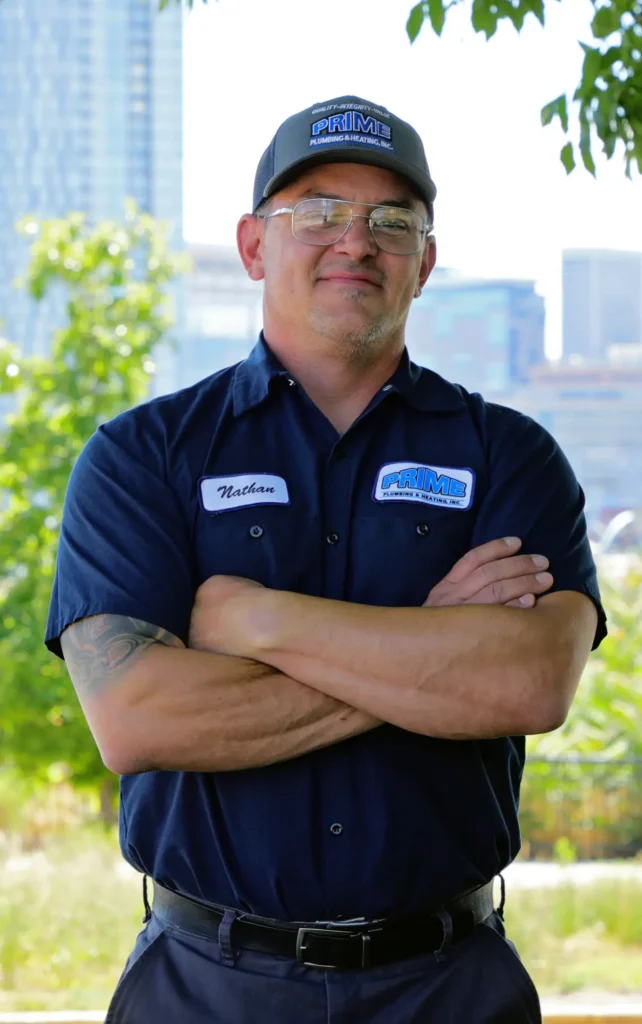
Nathan founded Prime Plumbing & Heating in 2012 after building his career across Denver’s residential and commercial plumbing trades over 27 years. He began his apprenticeship in 1998, graduated at the top of a class of 68, and earned his Colorado Master Plumber license in 2007.
He added his ICC National Standard Master Mechanical certification in 2013, and Prime holds Colorado Plumbing License #PC3045. A lifelong Denver native, Nathan personally sponsors the Denver Walk to End Alzheimer’s at City Park each year and writes and reviews all technical content on this site.
Posted onTrustindex verifies that the original source of the review is Google. Prime Plumbing came out to replace some parts on my tankless water heater. Fernando Cortez did a great job for a great price. Thanks Fernando!Posted onTrustindex verifies that the original source of the review is Google. I had a great experience with Fernando. He was professional, respectful, and very knowledgeable. He took the time to explain everything clearly. You can tell he genuinely cares about his work and represents the company extremely well. It’s hard to find reliable service these days, but this experience definitely exceeded my expectations. I would highly recommend them to anyone needing plumbing services.Posted onTrustindex verifies that the original source of the review is Google. Keaton and Trevor were the best!Posted onTrustindex verifies that the original source of the review is Google. PRIME was very prompt and informative. Fernando was great!Posted onTrustindex verifies that the original source of the review is Google. Fernando was very pleasant great personality. Professional he knew exactly what the problem was and how to fix it on a timely basis. Thank you!!!Posted onTrustindex verifies that the original source of the review is Google. Trevor is awesome .Posted onTrustindex verifies that the original source of the review is Google. My central air fan for the heater went out at the house, and right before this last snow and cold snap, but Gabriel at Prime Plumbing & Heating was quick to order the part and even gave me a space heater to use, till the part came in. Thanks Gabriel!Posted onTrustindex verifies that the original source of the review is Google. Fernando was such a big help! We have used Prime a couple of time at our office. They are always professional and include you in every step.Posted onTrustindex verifies that the original source of the review is Google. Great service, highly recommend using prime
Mon – Sun: 7am – 9pm