


By Nathan Padilla, founder of Prime Plumbing & Heating. ICC National Standard Master
Mechanical certified and a Colorado Master Plumber with more than 27 years in the trades.
If your furnace, boiler, or heat pump is already acting up in the fall, it probably isn’t going to hold up once Denver stays below freezing. I’ve been in the trades more than 27 years, a good share of that on home heating repair in Denver, and the people who call me in January almost always noticed something months earlier. Here’s what to watch for, and how urgent each one is.
The five heater repair signs worth acting on are inconsistent heat, short-cycling or constant running, higher bills without more comfort, unusual noises, and any change in smell or flame color. Two of those are scheduling calls. Two are same-day calls. One means shutting the system off before you do anything else.
As I’ve said in our own published guidance, “In Colorado, drastic temperature changes can affect your unit’s operation.” A system that’s already straining on a 35-degree October night has no margin left when the cold settles in for weeks at a time.
That matters more in Denver’s older neighborhoods, where the housing stock is older and so is the equipment inside it.
When one side of a house is 68 degrees and the other is 55, that usually points to one of three things. A cracked or compromised heat exchanger, duct leaks losing conditioned air before it reaches the far rooms, or a blower motor that can’t move air evenly anymore.
The cracked heat exchanger is the one I take seriously, because it isn’t only a comfort problem. A crack can let combustion gases into your living space. Duct leaks are more common and usually go unnoticed for years, since the loss builds up slowly.
Inconsistent home heating is a scheduling call, not an emergency. Get it looked at before December, when the same fault turns into a house that never warms up.
Short-cycling is when the system fires, runs a few minutes, quits before the house hits temperature, then starts over. A system that runs nonstop and still can’t reach setpoint is telling you the same story from the other direction.
Usual causes are a clogged filter choking airflow, equipment sized wrong for the house, a failing capacitor, or refrigerant loss in a heat pump. People often blame the thermostat. More often the thermostat is reading a problem correctly and the equipment can’t solve it.
This one is a same-day call. Every start and stop puts more stress on components than steady running does, and a system that can’t hold temperature in October won’t survive a sustained cold snap.
We can often be there the same day, sometimes within one or two hours, even when it isn’t an emergency. Call us at (720) 542-8153.
A heating bill that’s up over last year while the house feels the same is the system telling you something in the language of money. This is often the first thing homeowners notice, because it shows up on paper before it shows up in the living room.
Efficiency slips gradually. A dirty heat exchanger transfers less heat, scale inside a boiler does the same thing, aging parts work harder for the same output, and a heat pump low on refrigerant runs longer cycles to get where it’s going.
Pull last year’s bill for the same month and compare the usage, not the total, since rates change. If your therms or kilowatt-hours are up and your comfort isn’t, that’s a repair problem.
If cost is what’s holding you back, we have financing options available.
Some of the common heating problems in Denver homes announce themselves through sound before anything else. Three noises are worth knowing.
Banging or booming at startup is the one I’d call about today. It usually means delayed ignition, where gas builds in the combustion chamber before it lights, and that pressure release stresses the heat exchanger every single cycle.
Grinding or squealing points to motor bearing wear, and it’s a same-day call. Rattling from a loose panel or duct connection can wait for a scheduled visit, but don’t sit on it, because loose parts inside an air handler can find their way into something moving.
If you’re hearing any of this from a boiler specifically, our boiler repair page covers what we check.
These are the heating system problems homeowners should not ignore under any circumstances.
If you smell sulfur or rotten eggs near your furnace, boiler, or gas lines, that odor is added to natural gas so leaks get noticed. Shut the system off, leave the house without touching light switches or electronics, and call your gas utility from outside. Then call us at (720) 542-8153.
A healthy gas flame burns steady blue. A flame that’s mostly yellow or orange means incomplete combustion, which can mean carbon monoxide is being produced, and CO is colorless and odorless. If your CO detector sounds, treat it exactly like a gas smell. Get everyone out, and don’t restart the system until a technician has inspected it.
Schedule a visit within the week for uneven heat, minor rattling, or bills that are up without a clear reason. Those are real problems, but they aren’t emergencies yet.
Call for same-day Denver heating repair for short-cycling, a system that won’t reach setpoint, or grinding during operation. These escalate under winter load, and a week of waiting often turns a repair into a bigger one.
Shut the system down and call immediately for a gas smell, a yellow or orange flame, or a CO alarm. Don’t restart it until someone has cleared it.
The homeowners who call in October spend less and deal with far less disruption than the ones who wait until the system quits. A scheduled diagnostic is a standard call. A no-heat call at midnight in January, when it’s below zero and every technician in the metro is booked, is a different situation, and parts that sit on a shelf in October can take longer to get in February.
We quote the price before we start, so you know the number before anyone touches your equipment. If something isn’t right afterward, we come back and make it right. That’s the 100% satisfaction guarantee.
Annual inspections are the long-term answer to all of this, which is what our Total Home Care Club membership is built around, along with priority scheduling and exclusive member discounts. The membership covers your plumbing, heating, and cooling systems, so your heating inspection and your AC maintenance both fall under it.
We’re a family-owned company serving Denver, Arvada, Aurora, Broomfield, Commerce City, Lakewood, Thornton, and Westminster, from our office at 7000 Broadway Suite 205, Denver, CO 80221. I’m a Denver native. I grew up here, founded Prime here in 2012, took full ownership in 2016, and I’m not going anywhere.
When we dispatch a technician, you get a text with their name and an arrival window, so you’re not sitting home all day guessing. If the system turns out to be past repair, our furnace and boiler installation page covers replacement, and you can see everything we handle on our heating services page.
If you recognized one of these five signs, now is the time, not after the first hard freeze. I’m a straight shooter about this. “If I see it, I’m going to say it. And if I say I’m going to do something, I’m going to do it.”
Call us at (720) 542-8153 or schedule service today.
Uneven heat between rooms, short-cycling, higher bills without more comfort, new noises at startup, and any change in flame color or smell. If two of those are happening at once, get a diagnostic scheduled before winter puts sustained load on the system.
Uneven heat and light rattling can wait for a scheduled visit. Short-cycling or a system that won't hold temperature is same-day. A gas smell, a yellow flame, or a CO alarm means shut it off and call right away.
Usually a clogged filter, refrigerant loss in a heat pump, or a heat exchanger that isn't transferring heat the way it should. Sometimes the equipment is simply undersized for the home's heat loss on the coldest days. A diagnostic will tell you which.
A flame burning mostly yellow or orange instead of blue means incomplete combustion, and it can mean carbon monoxide is being produced. Shut the system off and call before restarting it. Flame color is one of the things our technicians record on every gas furnace check.
We quote all pricing upfront before any work starts, so there's no surprise on the invoice. Call for your specific situation, and ask about financing if cost is a concern.
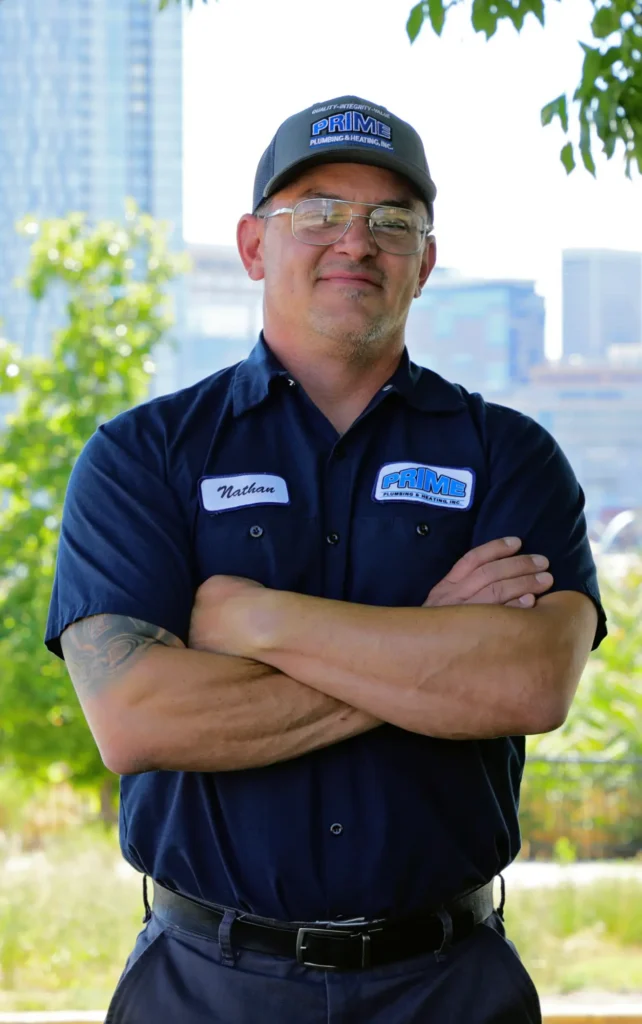
Nathan founded Prime Plumbing & Heating in 2012 after building his career across Denver’s residential and commercial plumbing trades over 27 years. He began his apprenticeship in 1998, graduated at the top of a class of 68, and earned his Colorado Master Plumber license in 2007.
He added his ICC National Standard Master Mechanical certification in 2013, and Prime holds Colorado Plumbing License #PC3045. A lifelong Denver native, Nathan personally sponsors the Denver Walk to End Alzheimer’s at City Park each year and writes and reviews all technical content on this site.
Posted on GoogleTrustindex verifies that the original source of the review is Google. Prime Plumbing came out to replace some parts on my tankless water heater. Fernando Cortez did a great job for a great price. Thanks Fernando!Posted on GoogleTrustindex verifies that the original source of the review is Google. I had a great experience with Fernando. He was professional, respectful, and very knowledgeable. He took the time to explain everything clearly. You can tell he genuinely cares about his work and represents the company extremely well. It’s hard to find reliable service these days, but this experience definitely exceeded my expectations. I would highly recommend them to anyone needing plumbing services.Posted on GoogleTrustindex verifies that the original source of the review is Google. Keaton and Trevor were the best!Posted on GoogleTrustindex verifies that the original source of the review is Google. PRIME was very prompt and informative. Fernando was great!Posted on GoogleTrustindex verifies that the original source of the review is Google. Fernando was very pleasant great personality. Professional he knew exactly what the problem was and how to fix it on a timely basis. Thank you!!!Posted on GoogleTrustindex verifies that the original source of the review is Google. Trevor is awesome .Posted on GoogleTrustindex verifies that the original source of the review is Google. My central air fan for the heater went out at the house, and right before this last snow and cold snap, but Gabriel at Prime Plumbing & Heating was quick to order the part and even gave me a space heater to use, till the part came in. Thanks Gabriel!Posted on GoogleTrustindex verifies that the original source of the review is Google. Fernando was such a big help! We have used Prime a couple of time at our office. They are always professional and include you in every step.Posted on GoogleTrustindex verifies that the original source of the review is Google. Great service, highly recommend using prime
Mon – Sun: 7am – 9pm